Most growing Melbourne businesses eventually hit the same wall: search visibility matters enough to need dedicated attention, but it’s not yet clear whether that attention should come from a salaried hire or an outsourced team. The honest answer is that it depends less on budget and more on how wide a skill set your search strategy now requires, and how much of that skill set a single person can realistically cover. For most businesses under a certain size, an agency delivers broader coverage per dollar. Past that size, a hybrid or in-house model often starts to win on control and institutional knowledge.
Table of Contents
- What does an in-house SEO hire actually cost?
- What range of skills does SEO and GEO work actually require now?
- When does hiring in-house actually make sense?
- A practical way to decide
- The bottom line
What does an in-house SEO hire actually cost?
Salary is the visible cost, but it’s rarely the whole cost. A mid-level in-house SEO specialist in Melbourne typically expects a market salary plus superannuation, and that figure assumes you can find someone with the right experience in a tight talent pool. On top of that sits the toolkit: a decent rank tracker, a technical crawler, a backlink or digital PR tool, and increasingly some form of AI visibility monitoring, since being cited by ChatGPT or Google AI Overviews requires checking signals that traditional rank trackers were never built to see. Add onboarding time, management overhead, and the cost of covering leave or turnover, and the true cost of ownership sits well above the headline salary.
The bigger issue isn’t cost, though. It’s coverage. Modern organic visibility spans technical SEO, content strategy, local search and Google Business Profile management, digital PR or link building, structured data and schema markup, and now generative engine optimisation (GEO): making sure AI tools can find, trust, and cite your business when someone asks them a question instead of typing it into Google. That’s a wide span of specialist skills. Very few individuals are genuinely strong across all of them. Most in-house SEO hires are good at two or three of these areas and competent at the rest, which is fine if your business only needs those two or three areas covered well. It becomes a gap if it doesn’t.
What range of skills does SEO and GEO work actually require now?
Traditional SEO used to be a reasonably contained discipline: keyword research, on-page optimisation, technical site health, and link acquisition. That skill set hasn’t gone away, but it’s no longer sufficient on its own. AI-generated answers now sit above or alongside traditional search results for a growing share of queries, and getting cited there depends on a different set of signals.
Based on how AI engines actually select sources to cite, the relevant skill areas now include:
- Technical SEO and site architecture, so the site can be crawled, indexed, and loads fast enough to be considered reliable.
- Structured data and schema markup (JSON-LD), which helps both search engines and AI models understand what your business is, what it offers, and where it operates.
- NAP consistency across your website, Google Business Profile, and directories, since AI tools cross-reference these to decide whether a business is verifiable.
- Answer-first content writing, structuring pages so they directly answer the specific questions customers ask, rather than burying the answer in marketing copy.
- Entity building, strengthening signals like a complete Google Business Profile, LinkedIn presence, and other verifiable data points that help AI engines trust a business is real and active.
- Local SEO, which remains foundational for service area businesses and overlaps heavily with the entity and NAP work above.
- Monitoring and reporting, specifically tracking AI citation rates and schema health over time, not just traditional keyword rankings.
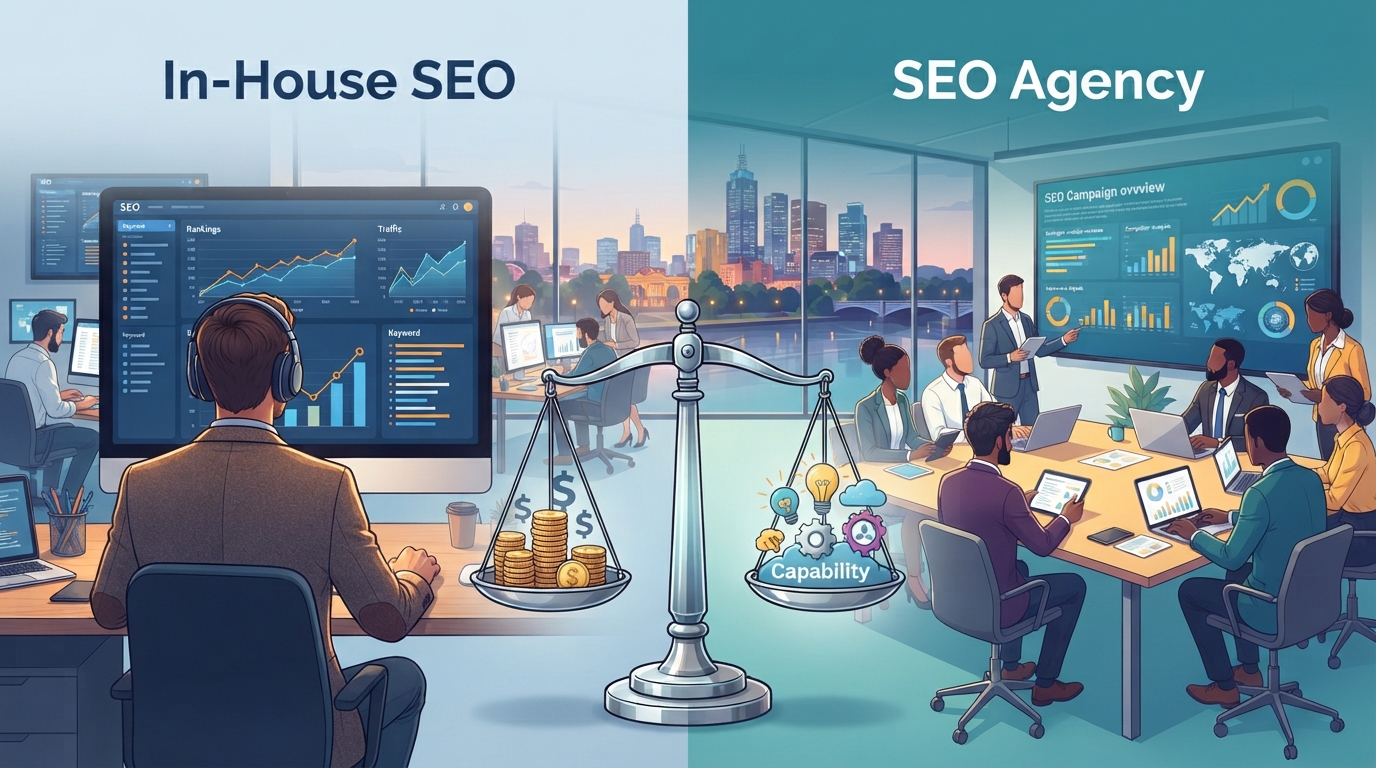
That’s at least six distinct disciplines, several of which barely existed as formal skill sets three years ago. Expecting one in-house hire to be genuinely expert across all of them is optimistic. It’s more realistic to expect strength in two or three, with the rest handled at a basic or outsourced level. This is the capability trade-off at the heart of the decision: an agency team can usually field a specialist (or at least a specialist-trained generalist) for each discipline, where an in-house hire is one person wearing every hat.
When does hiring in-house actually make sense?
In-house hiring tends to make sense once a business has enough scale and enough internal complexity that someone needs to be embedded in the business full-time to coordinate search strategy with product, content, sales, and customer service. If you’re running a large multi-location operation, have a content team that needs daily direction, or your SEO needs are tightly bound up with product launches and internal systems, having someone who sits in your meetings and understands your business from the inside has real value that no agency retainer replicates.
It also makes sense once your search needs are narrow enough that depth in one or two areas matters more than breadth. A business that has already solved its technical SEO and schema setup and mainly needs ongoing content production might do well with an in-house content-focused hire, supplementing technical and GEO work through a part-time consultant or agency engagement as needed.
For most growing Melbourne small and medium businesses, particularly trades, hospitality, and local service businesses, the picture usually looks different. These businesses need coverage across technical, local, content, and now GEO simultaneously, but don’t yet have the volume of work to justify a full-time salary for each discipline. This is the scenario where an agency’s pooled expertise tends to deliver more complete coverage per dollar than a single generalist hire, simply because the agency has already built the structured data, NAP consistency, and answer-first content processes across other clients and isn’t learning them from scratch on your site.
A practical way to decide
Rather than deciding on budget alone, map your actual needs against the six disciplines above and be honest about which ones are genuinely weak right now. If you can’t tell, a structured audit is a useful starting point, since it benchmarks your current standing across things like schema health, NAP consistency, and AI citation readiness rather than relying on guesswork. From there, the decision becomes clearer: if the gaps are narrow and specific, a targeted hire or contractor may close them efficiently. If the gaps span several disciplines at once, which is common for businesses that haven’t touched GEO at all yet, an agency engagement is likely to close more ground, faster, without the twelve-month commitment of a new hire.
The bottom line
There’s no universally correct answer to in-house versus agency. It’s a function of how many distinct skill areas your search strategy now needs covered, how deep your internal knowledge requirements are, and how much volume of work justifies a dedicated salary. For many growing Melbourne businesses still building out their GEO and AI search foundations, agency coverage closes more gaps for less total cost than a single hire can, at least until the business reaches a scale where embedded, full-time expertise pays for itself.
If you’re unsure which category your business falls into, starting with a GEO audit will give you a clearer, evidence-based picture of where your genuine gaps sit before you commit to either path.
See Your GEO Score in 60 Seconds
Find out exactly where your business stands on AI search — free, no credit card needed.
Get My Free GEO Audit