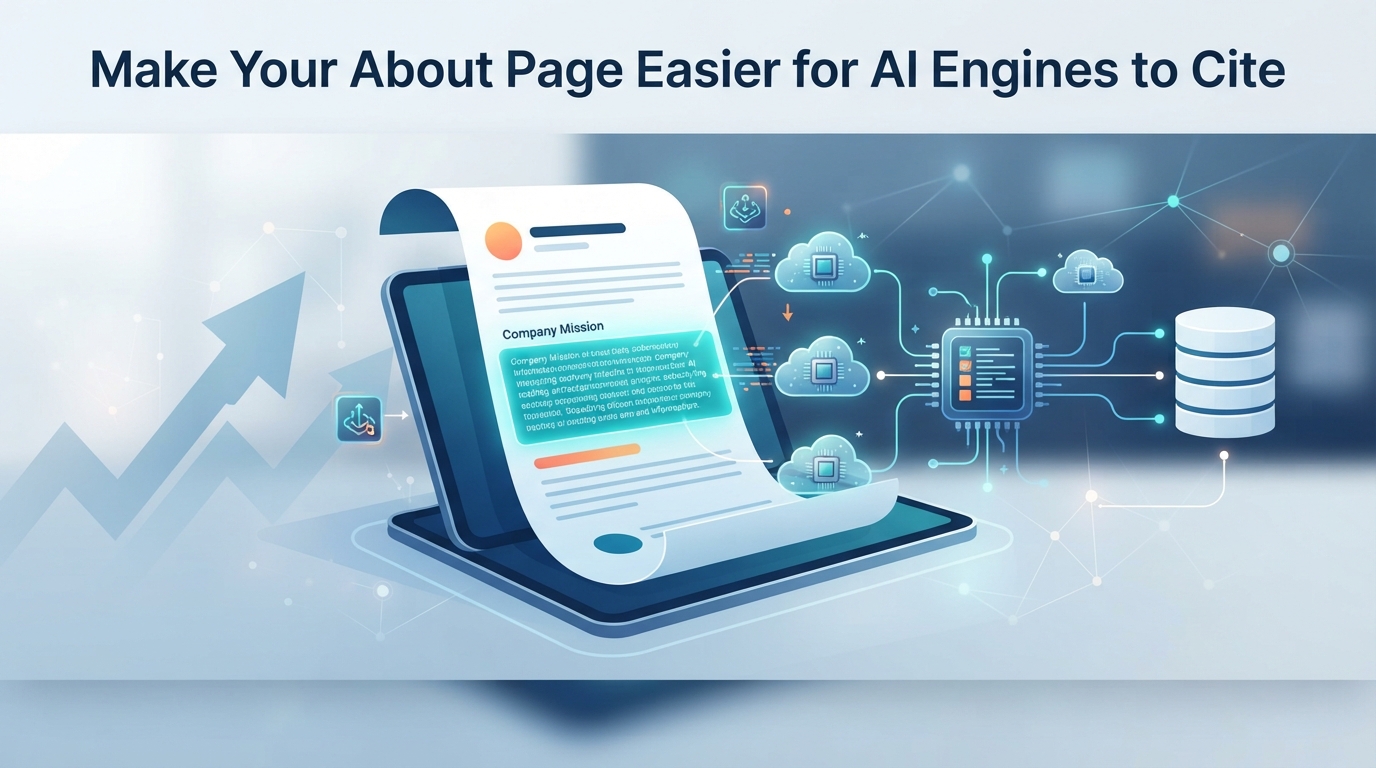
When ChatGPT, Perplexity or Google AI Overviews answer a question about your business, they need to lift facts from somewhere, and your About page is often the cleanest source available. Write it with explicit, unambiguous statements of what your business is, where it operates, who it serves and what makes it different, and state each fact once, clearly, rather than burying it in marketing copy. AI engines favour pages that read like a reliable reference, not a pitch.
This matters more than it used to. People increasingly ask AI tools to recommend a local business rather than typing a search and scrolling results. If the AI can’t quickly confirm what you do and where, it will cite a competitor whose About page made the job easier. Here’s how to structure yours so it’s actually usable as a source.
Table of Contents
- What should the first paragraph say?
- What specific facts should an About page clearly state for AI engines to extract?
- Does writing style or sentence structure affect whether AI tools quote a page?
- Should schema markup be added to the About page as well?
- Putting it together
What should the first paragraph say?
Treat the opening paragraph as the one an AI engine is most likely to lift verbatim. It should state, in plain sentences:
- What the business is (the category, not just the brand name)
- Where it operates (suburb, city, state, or service area)
- What it does, in concrete terms
- Who it’s for
For example: “RankMeFirst.ai is a Generative Engine Optimisation agency based in Melbourne, helping Australian small businesses appear in answers from ChatGPT, Google AI Overviews and Perplexity.” That sentence contains four extractable facts. Compare that with an opening that leads with a mission statement or a rhetorical question about how the world has changed. It might be engaging to a human reader, but it gives an AI nothing concrete to quote until several sentences in, and by then it may have moved on to a competitor’s page.
What specific facts should an About page clearly state for AI engines to extract?
Beyond the opening paragraph, make sure the page separately and clearly states:
- Legal and trading name, if they differ
- Physical location or service area, written the same way it appears on your Google Business Profile and other directories
- Founding or operating history, if relevant (even approximate, honestly stated)
- Services offered, named specifically rather than described abstractly
- Who you serve, by industry, location or customer type
- Team size or structure, if it’s a genuine point of difference (a solo operator versus a team of twelve is a real distinguishing fact)
- Contact details, matched exactly to your other listings
Each of these should appear as its own clear statement somewhere on the page. Don’t make an AI engine infer your location from a photo caption or a footer logo. If a fact is important enough for a customer to know, it’s important enough to write as a complete sentence.
Does writing style or sentence structure affect whether AI tools quote a page?
Yes, and this is the part most business owners get wrong. AI engines extract text more reliably when it’s structured as direct, self-contained statements: one claim per sentence, subject first, no dependent clauses stacked on top of each other. Sentences like “Since our founding, driven by a passion for excellence, we have aimed to be the kind of business that…” contain almost no extractable fact. A sentence like “RankMeFirst.ai has operated in Melbourne since 2024 and serves clients in Sydney, Brisbane and Perth” is easy to lift cleanly.
Short paragraphs under subheadings help too, because AI systems often process content in chunks rather than reading an entire page as one block. If your “How We Work” section is one long paragraph of brand voice, break it into short, labelled statements instead. This is the same principle behind answer-first content more broadly, where the direct answer comes before the elaboration, not after it.
It’s also worth being honest about numbers. Only state a statistic, timeframe or outcome if you can stand behind it; vague claims (“industry-leading”, “trusted by hundreds”) are the opposite of quotable, because there’s no fact underneath them for an AI engine to verify or repeat.
Should schema markup be added to the About page as well?
Yes. Written content tells a human reader (and, increasingly, an AI system reading in natural language) what your business is, but structured data in the form of JSON-LD schema gives machines the same facts in a format they can parse with certainty. An Organization or LocalBusiness schema block listing your name, address, phone number, service area and founding details reinforces exactly what your About page says in prose. The two should always match: inconsistent name, address or phone details between your visible text, your schema and your Google Business Profile is one of the more common reasons AI engines lose confidence in a business as a source. If you’re not sure what’s currently present on your site, a GEO audit will check schema health alongside the other signals AI engines weigh up.
Putting it together
A genuinely quotable About page reads less like brand storytelling and more like a well-written Wikipedia entry: direct, factual, specific, and consistent with how your business is described everywhere else online. Lead with the facts, state them once clearly, back them with matching schema, and resist the urge to open with a mission statement before the who-what-where is established.
If you want a clearer picture of how your current About page and site structure are performing on these signals specifically, RankMeFirst.ai’s free GEO audit checks schema health, NAP consistency and answer-first content as part of a broader scorecard, which is a useful starting point before you start rewriting.
See Your GEO Score in 60 Seconds
Find out exactly where your business stands on AI search — free, no credit card needed.
Get My Free GEO Audit