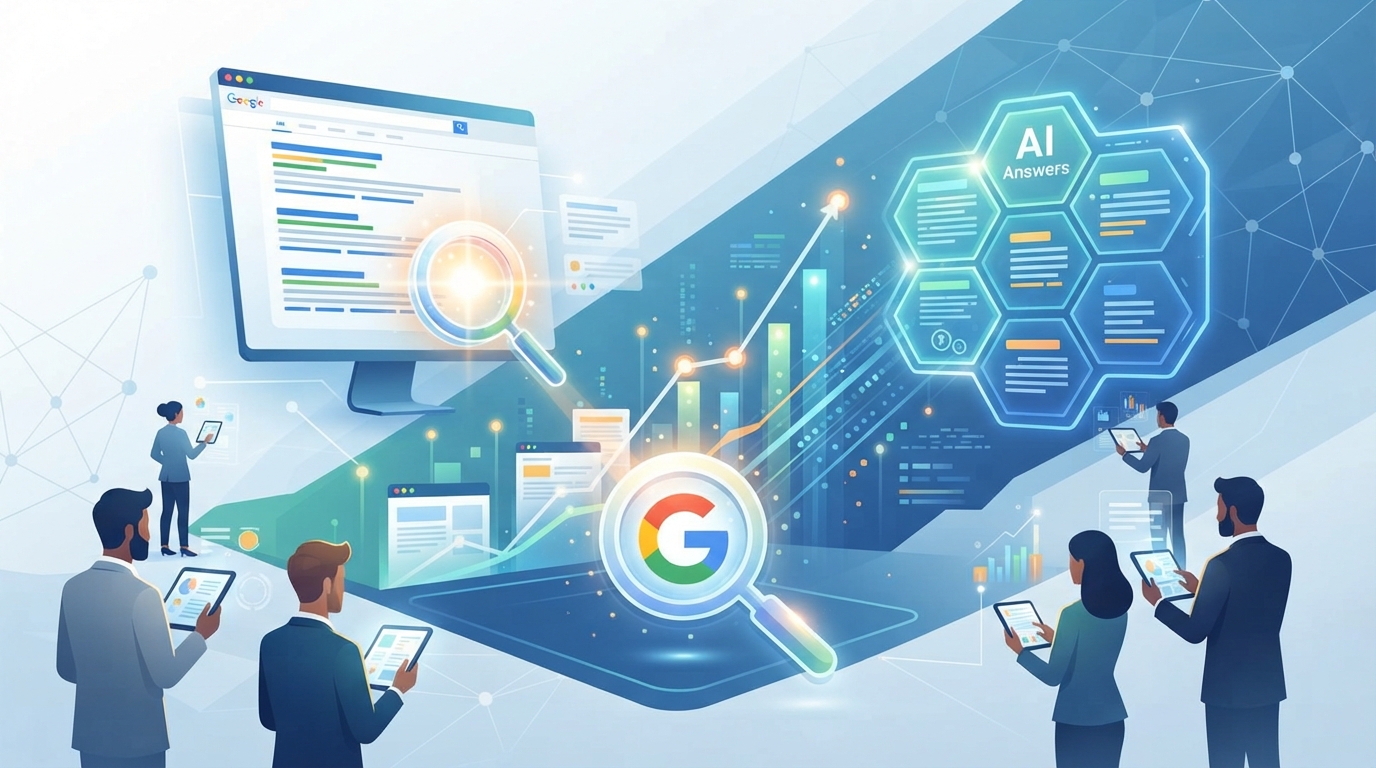
Websites earn visibility in Google by convincing an algorithm they are relevant, trustworthy and usable, and they earn visibility in AI answer engines like ChatGPT, Perplexity and Google AI Overviews by convincing a language model they are a credible, verifiable source worth citing. The two systems overlap more than most people expect, but they are not the same thing, and a site can do well in one while being invisible in the other. This article walks through both, plainly, so you know what to focus on first.
Table of Contents
- What are the main factors Google uses to rank a website?
- How is ranking in AI answers different from traditional search results?
- What can a small business realistically control?
- Where this leaves you
What are the main factors Google uses to rank a website?
Google has never published its full ranking algorithm, and anyone who claims to know the exact formula is guessing. But after decades of public statements, patents and independent testing by the SEO industry, a few factors are widely accepted as foundational.
Relevance. Does the page actually answer the question the searcher typed? Google matches intent, not just keywords, which is why stuffing a page with a phrase repeatedly stopped working years ago.
Content quality and depth. Pages that genuinely cover a topic, with accurate and specific information, tend to outperform thin or generic pages. Google has talked publicly about rewarding content that demonstrates experience and expertise on a subject.
Backlinks. Other reputable websites linking to yours still function as a trust signal, roughly the digital equivalent of a referral. Quantity matters less than the credibility of the sites linking to you.
Technical health. Page speed, mobile usability, secure connections and clean site structure all affect whether Google can crawl, index and confidently rank a page. A slow or broken site can undermine otherwise strong content.
User experience signals. Whether people click through, stay, and don’t immediately bounce back to the results page is believed to factor into rankings, even if the exact weighting is unclear.
Local signals. For businesses with a physical location or service area, a well-maintained Google Business Profile and consistent business details across the web play a major role in local pack visibility, separate from standard organic ranking.
None of these factors work in isolation. A technically perfect website with thin content won’t rank, and brilliant content buried on a slow, poorly structured site often won’t either.
How is ranking in AI answers different from traditional search results?
This is where the ground has shifted fastest, and where most small business owners are currently underinformed.
Traditional Google search returns a list of links and lets the user decide which to click. AI answer engines do something different: they generate a single synthesised response and decide, on the user’s behalf, which sources to draw from and cite. Being “findable” is no longer enough. The question becomes whether an AI model trusts your business enough to reference it directly in an answer.
That trust is built on different, and in some ways more specific, signals than classic SEO:
- Structured data (schema markup). Code embedded in a webpage that explicitly tells machines what a business is, what it offers, where it’s located and what it charges. AI systems rely heavily on this to verify facts quickly rather than inferring them from paragraphs of text.
- Entity consistency. AI engines build a picture of a business as an “entity” by cross-referencing multiple sources: your website, Google Business Profile, LinkedIn, directories and other mentions. If your business name, address and phone number vary across these, it weakens confidence in that entity.
- Answer-first content structure. Content that states a clear answer early, in plain language, is easier for an AI model to lift and cite than content that buries the answer under long narrative introductions.
- Verifiability. Because AI engines are trying to avoid hallucinating facts, they favour businesses with corroborating signals across the web over businesses that only exist as a single, unlinked website.
It’s entirely possible to rank well on page one of Google and still be invisible in ChatGPT or an AI Overview, because the underlying systems are evaluating different things. A business with strong backlinks and years of domain authority might still be skipped by an AI engine if its schema is missing or its NAP (name, address, phone) details are inconsistent across the web. For a closer look at why this gap exists, RankMeFirst.ai’s article on why Google rankings do not guarantee visibility in ChatGPT goes into more detail on this specific disconnect. There’s also a useful explainer on what Google AI Overviews are and how they affect business discovery, since AI Overviews sit in an interesting middle ground between traditional search and generative answer engines.
What can a small business realistically control?
It’s worth separating what you can influence directly from what you can only indirectly encourage, because this is where most people waste effort.
Directly controllable:
- Your website’s structured data. Adding accurate JSON-LD schema for your business type (local business, service, menu, FAQ, and so on) gives both Google and AI engines a clean, machine-readable summary of who you are.
- Consistency of your business details. Your name, address and phone number should match exactly across your website, Google Business Profile, directories and social pages. Small inconsistencies, like “St” versus “Street,” sound trivial but genuinely undermine trust signals.
- Content that answers real questions directly. Write the answer to a customer’s question in the first sentence or two of a section, then expand with detail. This helps human readers skim and helps AI systems extract a clean, quotable answer.
- Technical fundamentals. Fast load times, mobile-friendly design and a logically structured site remain table stakes for both classic SEO and AI visibility.
- Your Google Business Profile. For any business serving a local area, keeping this complete, accurate and active is one of the highest-leverage, lowest-cost things you can do.
Harder to control directly, but worth monitoring:
- Whether other websites choose to link to or mention you.
- Whether an AI engine has already indexed outdated or incorrect information about your business, which can persist even after you fix the source.
- The internal weighting each AI engine or Google update applies to any given signal, which changes over time without notice.
A practical starting point is simply finding out where you currently stand. Checking what AI tools already say about your business, and comparing that to reality, often reveals gaps that are otherwise invisible. There’s a guide on how to check what AI search tools say about your business that walks through a basic version of this process, and a related piece on five signs your business is missing from AI search results if you suspect you’re already behind. For those wanting to understand the content side specifically, how to write website content that AI engines are more likely to quote is a sensible next read.
Where this leaves you
Earning visibility in Google still rewards relevant, well-structured, genuinely useful content backed by technical soundness and credible links. Earning visibility in AI answer engines asks for the same foundation, plus machine-readable structure, consistent entity data and content written to be directly quotable. Neither system is mysterious once you break it into its parts, but both reward patience: changes typically take weeks, not days, to show up in results.
If you want a clearer picture of where your own website currently stands against these signals, a GEO audit is a reasonable next step, since it benchmarks a site against the specific factors AI engines and Google both rely on, rather than leaving you to guess.
See Your GEO Score in 60 Seconds
Find out exactly where your business stands on AI search — free, no credit card needed.
Get My Free GEO Audit