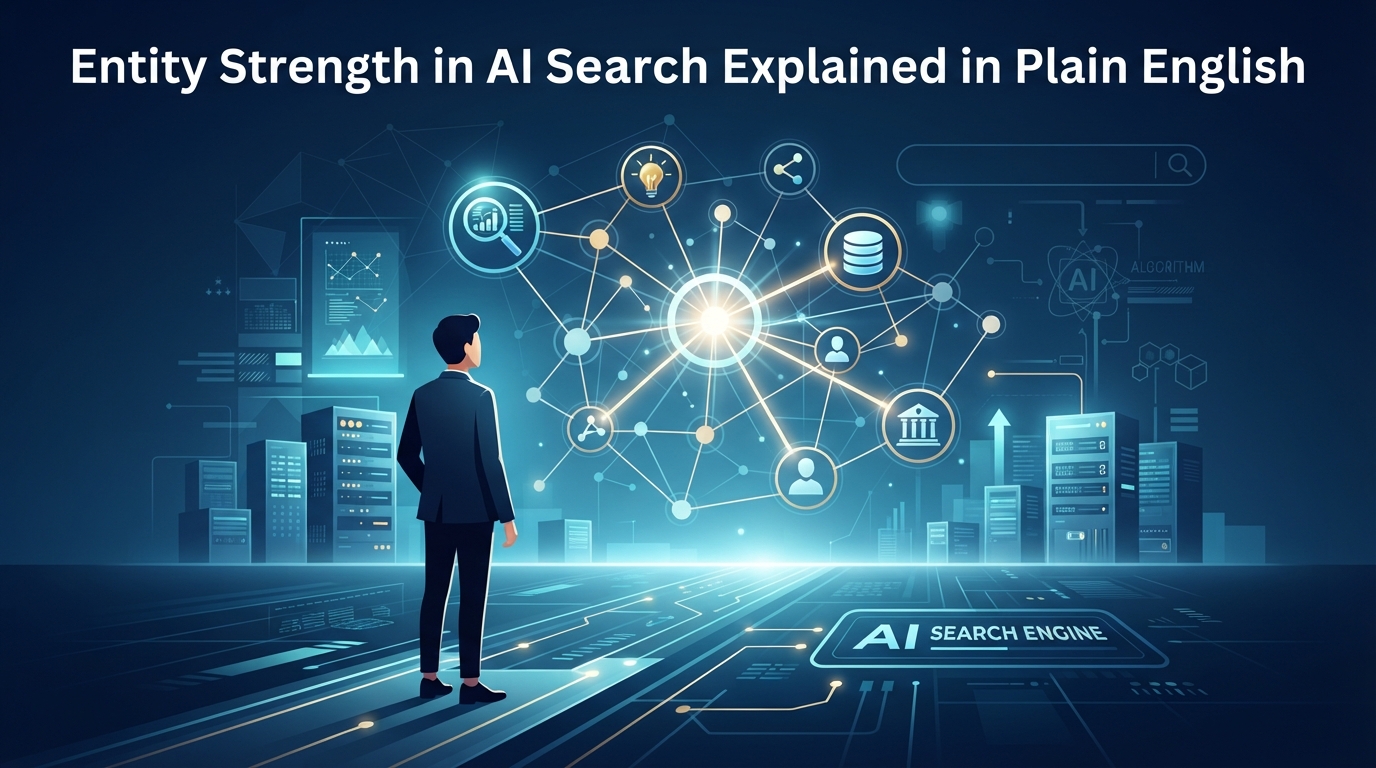
Entity strength is a measure of how confidently AI systems can confirm that your business is a real, specific, verifiable thing, rather than just a collection of words on a webpage. When ChatGPT, Google AI Overviews or Perplexity generate an answer to “who’s a good electrician in Richmond?”, they need to be sure they’re recommending an actual business with a real location, a consistent identity, and a track record they can cross-check. Entity strength is their shorthand for that confidence. The stronger it is, the more likely your business gets named in the answer instead of a competitor’s.
Table of Contents
- Why does this concept even exist?
- How is entity strength different from traditional SEO ranking factors?
- What builds a strong business entity online?
- Can a small business improve entity strength quickly?
- Where entity strength fits in the bigger picture
Why does this concept even exist?
Traditional search engines worked by matching keywords and ranking pages. AI-generated answers work differently: the AI has to decide which businesses are trustworthy enough to recommend by name, often without a user ever clicking through to a website. That’s a bigger leap of faith than showing ten blue links, so AI systems lean heavily on corroborating evidence from multiple sources before they’ll cite you.
Think of it like a reference check. If only your own website says you exist and where you’re located, that’s one uncorroborated source. If your Google Business Profile, LinkedIn page, industry directories and structured data on your site all agree on the same name, address and details, that’s several independent sources confirming the same facts. AI models are trained to weight consensus like this heavily, because it reduces the risk of recommending a business that’s closed, fake, or mismatched to what the user asked for.
How is entity strength different from traditional SEO ranking factors?
Traditional SEO factors, like backlinks, keyword density or page authority, are mostly about whether a page deserves to rank for a search term. They answer the question “is this content relevant and authoritative?” Entity strength answers a different question: “does this business actually exist as a coherent, verifiable identity, separate from the content on any one page?”
The distinction matters practically. A business could have a well-optimised page targeting “emergency plumber Melbourne” that ranks reasonably in classic Google search, yet still be invisible in AI answers because the AI can’t confidently link that page to a specific real-world business. That happens when there’s no structured data (JSON-LD schema) telling machines “this is a Plumber, this is its name, this is its address, this is its phone number,” and when the business’s details are inconsistent across the web, such as a slightly different address on a directory listing versus the website footer.
So while SEO factors are largely about content and links, entity strength is about identity and verification. It’s less “is this page good” and more “is this business real and knowable.” Both matter, but they’re solving different problems, and a business can be strong in one and weak in the other.
What builds a strong business entity online?
A handful of concrete signals tend to matter most:
Consistent NAP data. Name, Address and Phone number should be identical, not just similar, across your website, Google Business Profile, and any directories or citations you appear in. A business listed as “J. Smith Plumbing” in one place and “Smith’s Plumbing Services” in another creates ambiguity that makes it harder for AI systems to be certain they’re looking at the same entity.
Structured data (schema markup). JSON-LD schema on your website is essentially a machine-readable label that says “this is a business, here’s its category, name, location and contact details.” Without it, AI systems have to infer these facts from unstructured text, which is slower and less reliable.
Verifiable third-party presence. A Google Business Profile, an active LinkedIn page, listings in recognised directories, and where applicable, structured location data linked to sources like Wikipedia or Wikidata, all act as independent corroboration. The more consistent, verifiable touchpoints there are, the more confidently an AI can treat your business as a known entity rather than a guess.
A track record over time. Entities that have existed consistently, with a stable name and address, tend to accumulate more corroborating signals simply because they’ve had time to appear in more places correctly.
None of these signals alone makes or breaks entity strength. It’s the combination and consistency across all of them that builds confidence.
Can a small business improve entity strength quickly?
Some improvements are genuinely quick. Correcting inconsistent NAP details across your website and existing directory listings, and installing accurate JSON-LD schema, are largely mechanical fixes that don’t require months of work once identified. These tend to be the first things worth checking, because they’re low effort and high impact relative to other GEO work.
Other improvements take longer by nature. Building a credible LinkedIn presence, accumulating consistent citations across directories, or establishing structured location data takes sustained effort rather than a single fix. There’s no shortcut to a track record; it accumulates.
A realistic expectation is that the low-hanging fixes (schema, NAP consistency) can be sorted within weeks, while the broader entity-building work is ongoing. Anyone promising instant, dramatic entity strength gains for a small business is probably overselling what’s a genuinely gradual, evidence-based process.
Where entity strength fits in the bigger picture
Entity strength is one of several signals that determine whether AI systems cite a business, alongside things like schema health, answer-first content structure, and overall AI visibility. It’s not a standalone fix, it’s a foundation. A business with excellent content but weak entity signals may still struggle to be cited, because the AI simply isn’t confident it’s recommending a real, verifiable business.
If you’ve seen “entity strength” flagged in an audit report and want to understand exactly where your business stands and what’s realistically fixable first, a GEO audit will show your entity strength score alongside the other signals AI engines use, giving you a clear, prioritised starting point rather than a guessing game.
See Your GEO Score in 60 Seconds
Find out exactly where your business stands on AI search — free, no credit card needed.
Get My Free GEO Audit