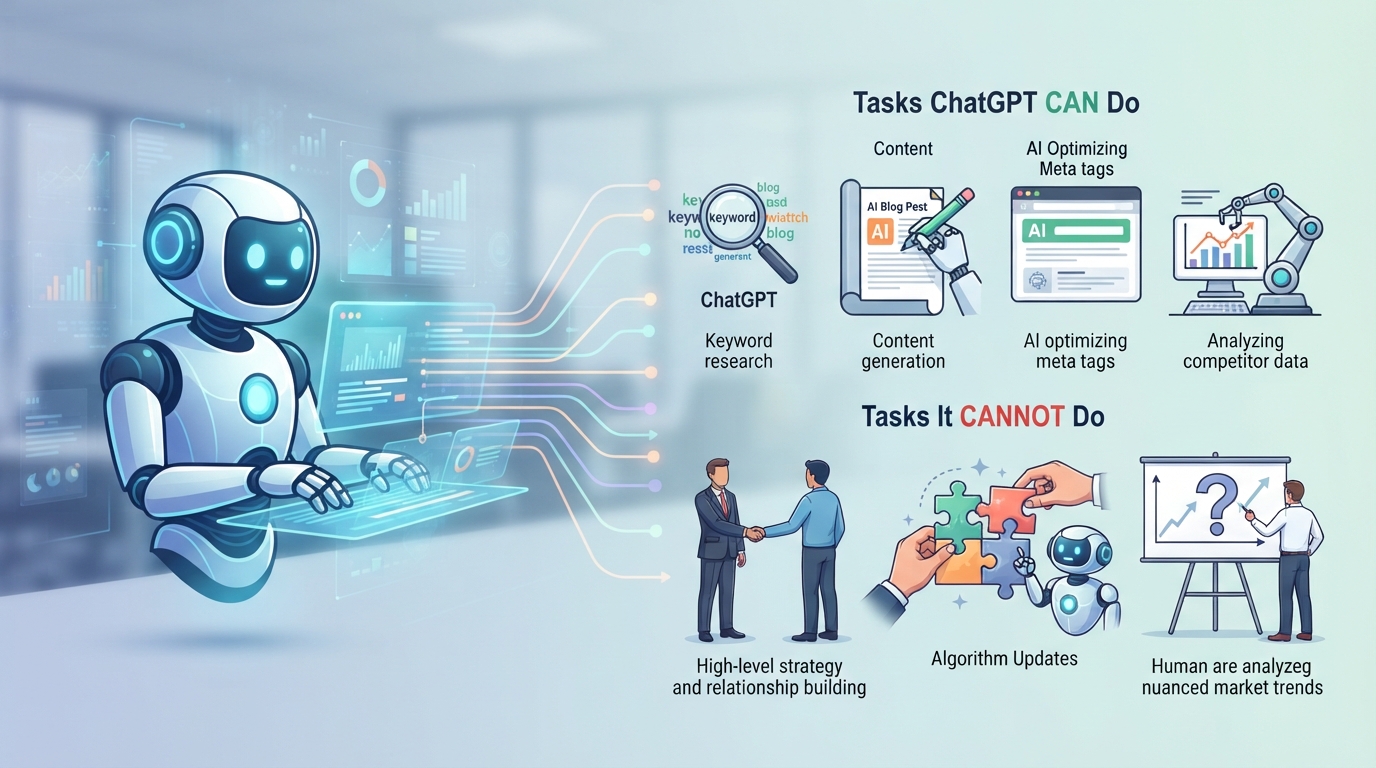
ChatGPT can genuinely help with parts of your SEO, particularly brainstorming, drafting and explaining concepts, but it cannot do the technical and structural work that determines whether Google or AI engines trust your business enough to cite it. The honest answer is that ChatGPT is a useful assistant for some SEO tasks and a poor substitute for others. Knowing which is which will save you time and stop you from assuming a chat window has fixed problems it never touched.
Table of Contents
- What ChatGPT is actually good at
- Can ChatGPT write content that actually ranks or gets cited?
- What technical SEO tasks is ChatGPT unable to perform on its own?
- How should a business combine ChatGPT with professional SEO or GEO work?
- The bottom line
What ChatGPT is actually good at
ChatGPT is a language model. It’s genuinely strong at tasks involving language: drafting, summarising, explaining, and rephrasing. Used well, it can speed up several parts of an SEO workflow.
Keyword and topic brainstorming. ChatGPT can suggest question variations, related topics and customer language you might not have thought of. It won’t know your actual search volume or competition, but as a starting point for “what might my customers be typing or asking” it’s genuinely useful.
First drafts of content. Blog posts, service page copy, FAQ answers. ChatGPT can produce a reasonable first draft quickly, which you or a writer can then fact-check, localise and tighten. The time saved is real, provided you treat the output as a draft, not a finished page.
Explaining technical concepts. If you don’t know what schema markup is, or why NAP consistency matters, ChatGPT can explain it clearly. It’s a decent tutor for building your own understanding of SEO and GEO concepts.
Meta descriptions and title tag ideas. Useful for generating options to choose from, though you still need to check length, relevance and whether they match what the page actually delivers.
Spotting gaps in existing content. Paste in a page and ask what questions it doesn’t answer. This is one of the more genuinely useful applications, because it mimics how an AI engine might assess whether your page is “answer-first” enough to cite.
Can ChatGPT write content that actually ranks or gets cited?
This is the question most business owners actually want answered, and the honest answer is: sometimes, and not by itself.
Ranking in Google and being cited by AI engines like ChatGPT, Perplexity or Google AI Overviews depend on more than the words on the page. Google’s systems and AI answer engines assess trust signals that live outside the text: whether your business entity is verifiable, whether your NAP (name, address, phone) data is consistent across your site, Google Business Profile and directories, whether structured data (JSON-LD schema) correctly describes what your business is, and whether other credible sources corroborate who you are.
ChatGPT has no visibility into any of that. It can write a well-structured, answer-first paragraph, but it cannot verify your business exists, cannot check if your NAP data matches across the web, and cannot confirm whether your site even has schema installed. A beautifully written page sitting on a technically invisible website is still invisible.
There’s also a practical trap: AI-generated content that reads as generic, or that repeats common phrasing found across thousands of other AI-assisted pages, can actually work against you. Both Google’s ranking systems and AI citation behaviour tend to favour content that demonstrates specific, verifiable expertise, not content that sounds like it could have been written about any business in any town. If you use ChatGPT for drafting, the editing pass that adds real detail, specific experience and local context is not optional; it’s where most of the value gets added.
What technical SEO tasks is ChatGPT unable to perform on its own?
This is where the limits become clear, and where most of the actual ranking and citation work happens.
Schema markup implementation. ChatGPT can write you a sample JSON-LD snippet, but it cannot install it on your site, verify it validates correctly, or check it matches your actual business type and structured data requirements. Schema health, one of the core signals AI engines use to decide who to cite, requires technical implementation and checking, not just a code sample in a chat window.
NAP consistency auditing. ChatGPT cannot scan the internet to check whether your business name, address and phone number match across your website, Google Business Profile, directories and citations. This requires actual crawling and checking against live data, something a chat model doesn’t do.
Entity strength building. Whether your business has a strong, verifiable entity presence (Google Business Profile completeness, LinkedIn presence, consistent location data) is a structural, multi-platform issue. ChatGPT can tell you entity strength matters; it cannot build or verify it.
Site speed, crawlability and indexing. Technical performance factors like Lighthouse scores, load times and whether search engines can actually crawl your pages are server-side and code-level issues. No amount of prompting fixes a slow site.
Checking current AI citation status. You can ask ChatGPT about your business, but its response in a single chat session doesn’t reliably tell you whether you’re being cited consistently across real user queries, or whether competitors are being cited instead. That requires ongoing, structured monitoring, not a one-off question.
Local SEO signals. Google Business Profile optimisation, review management, and local directory consistency are operational tasks requiring access to platforms ChatGPT cannot log into or act on.
How should a business combine ChatGPT with professional SEO or GEO work?
A sensible approach treats ChatGPT as a drafting and research assistant sitting alongside, not instead of, the structural work.
A practical sequence looks like this: use ChatGPT to brainstorm topics and draft content, have someone (you, a writer, or an agency) fact-check and localise that content with real detail about your business, and separately commission a technical audit that checks the things ChatGPT cannot see: your schema, your NAP consistency, your entity signals, and your actual current visibility in AI answers. Content and technical trust signals need to improve together. Great content on a technically weak site, or a technically sound site with thin content, both tend to underperform.
This is the gap RankMeFirst.ai’s GEO audit is built to address: it checks the six signals (AI Visibility, Schema Health, NAP Consistency, Answer-First Content, Entity Strength, and AI Citation Readiness) that determine whether ChatGPT, Perplexity and Google AI Overviews actually cite a business, then prioritises fixes by impact rather than handing over a generic checklist.
The bottom line
ChatGPT is a genuinely useful tool for drafting, explaining and brainstorming, and a poor substitute for the technical and entity work that determines whether your business gets found and cited. Business owners who use it for the former while getting the latter checked properly tend to get further, faster, than those trying to make it do both. If you’re unsure which category your own website falls into, a GEO audit will tell you exactly where the gaps are before you spend more time drafting content that a technically invisible site can’t make use of.
See Your GEO Score in 60 Seconds
Find out exactly where your business stands on AI search — free, no credit card needed.
Get My Free GEO Audit