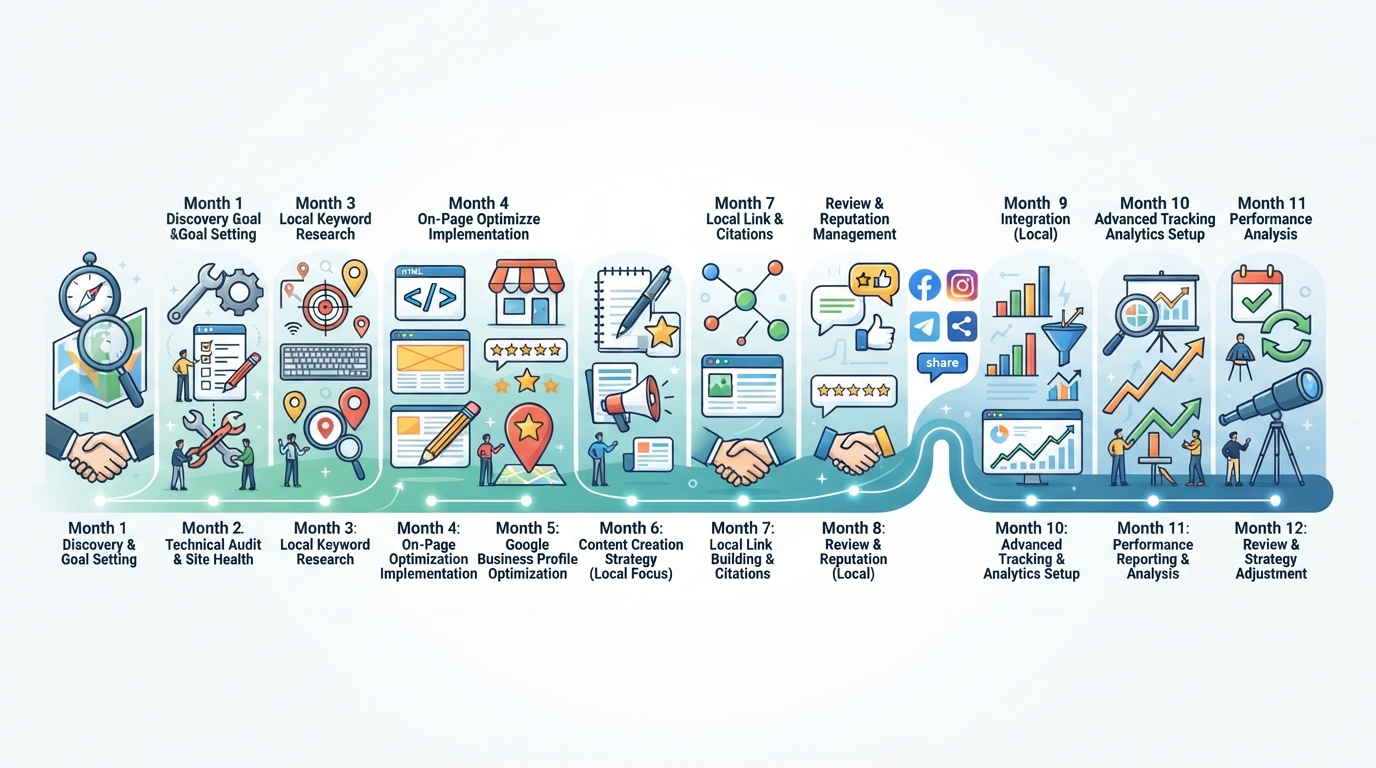
A GEO engagement typically moves through three overlapping phases: an audit and setup month where no visible results should be expected yet, a build phase from around month two through four where citation and visibility changes usually start appearing, and an ongoing monitoring phase from month four onwards where the work shifts from fixing to maintaining and expanding. Knowing this rhythm in advance is what lets a business judge whether an agency is actually making progress or just billing hours.
Most hesitation around committing to GEO comes from not knowing what “the work” looks like once the contract is signed. Unlike a one-off website redesign, GEO is an ongoing discipline because AI engines re-crawl, re-index and re-evaluate trust signals on their own schedules, not yours. Here’s a realistic breakdown of what each stage typically involves.
Table of Contents
- What happens in month one before any results appear?
- How soon can a business expect to see citation or visibility changes?
- What does month three and four typically involve?
- What ongoing work is needed after the initial setup phase?
- Setting realistic expectations month to month
What happens in month one before any results appear?
The first month is almost entirely diagnostic and structural. Nothing a customer sees on ChatGPT or Google AI Overviews should change in week one, and that’s expected, not a red flag.
A proper engagement starts with a full audit across the signals AI engines actually use to decide who to cite: whether the business is already being surfaced, how complete and valid its structured data (JSON-LD schema) is, whether its name, address and phone number match across its website, Google Business Profile and directories, whether its content answers customer questions directly rather than burying them in marketing copy, and how strong its overall “entity” signals are, things like a verified Google Business Profile, consistent social profiles, and any linked location data.
Once the audit findings are in, month one typically includes:
- Prioritising fixes by impact, not by what’s easiest to do first. Schema errors and NAP inconsistencies usually get tackled before content rewrites, because they’re faster to fix and tend to influence whether AI engines trust a source at all.
- Technical schema implementation, adding or correcting JSON-LD markup so AI crawlers can parse exactly what the business is, where it operates, and what it offers.
- NAP clean-up, reconciling the business’s name, address and phone number across its website, Google Business Profile, and major directories. Inconsistencies here are one of the more common reasons AI engines skip over an otherwise good business.
- A content audit, identifying which existing pages are structured as answers to real customer questions and which are not.
This month is slow by design. Structural fixes need to be implemented correctly before any content or distribution work builds on top of them. A business that expects citation changes in week two will be disappointed; a business that understands this is foundation-laying will have realistic expectations for month two onward.
How soon can a business expect to see citation or visibility changes?
Based on typical timelines for this kind of work, structural fixes such as schema correction and NAP consistency tend to show measurable effect within four to six weeks, since AI engines can re-crawl and re-evaluate a site reasonably quickly once the technical signals are clean. Content restructuring, rewriting pages to directly answer customer questions in the way AI engines prefer to extract and cite, typically takes longer to show up, often six to eight weeks, because it depends on when AI engines re-index that content and decide to trust it as a source.
This means month two and three are usually where the first tangible signs appear, not transformational results, but early indicators such as:
- The business starting to appear in AI-generated answers for a narrow set of queries it wasn’t appearing in before.
- Improved schema health scores in monitoring reports.
- Entity strength ticking up as verified profiles and consistent citations compound.
It’s worth being upfront that this is a probabilistic process, not a guaranteed one. AI engines decide what to cite based on signals of trust and relevance, and no agency can promise a specific citation will appear by a specific date. What a reasonable engagement can promise is that the right signals are being strengthened and tracked, and that progress is visible in the data even before it’s visible in a ChatGPT response.
What does month three and four typically involve?
By this stage the work shifts from “fix what’s broken” to “build out what’s working.” This is where answer-first content becomes the main focus:
- Expanding content to cover more of the questions customers actually ask AI engines, rather than the keyword phrases they’d type into Google ten years ago. This often means restructuring service pages so the first two or three sentences directly answer a likely question, with supporting detail after.
- Strengthening entity signals further, which can include ensuring consistency across LinkedIn, industry directories, and any location data that AI engines can cross-reference.
- Re-auditing and comparing against the original baseline, to see which fixes have moved the needle and which need another pass.
This is also typically when monthly reporting becomes genuinely useful, because there’s now a baseline to compare against. Reports at this stage should show trend lines, not just snapshots: is the schema health score climbing, is NAP consistency holding steady across new directories, is the business starting to appear for a wider range of AI-generated queries than it did in month one.
What ongoing work is needed after the initial setup phase?
GEO isn’t a project with a finish line in the way a website build is. After the initial three to four months of structural and content work, the engagement typically settles into a monitoring and refinement cycle. This matters because AI engines update their models, re-crawl sites, and change how they weight signals, so a business that was well-optimised in month four can quietly lose ground by month eight if nobody’s watching.
Ongoing work generally includes:
- Regular monitoring scans to catch schema errors, NAP drift (a new directory listing with a slightly different phone number, for instance), or drops in AI visibility before they compound.
- Periodic content additions as new questions emerge or as the business expands into new services or locations.
- Re-auditing on a scheduled basis rather than only when something looks wrong, since AI citation patterns can shift without any obvious trigger.
- Reporting that tracks citation rate, schema health, and entity strength over time, so the business can see whether the investment is compounding or plateauing.
The practical implication for buyers: ask any agency what the month-four-onward cadence looks like, not just what happens in month one. A credible engagement should be able to describe a monitoring rhythm, not just an initial fix list. If the answer is vague past the first eight weeks, that’s worth probing.
Setting realistic expectations month to month
The pattern worth remembering is this: month one is diagnostic and largely invisible, months two to four are where structural fixes start showing measurable effect and content work ramps up, and month four onward is a maintenance and expansion cycle that should continue for as long as the business wants to stay visible to AI search. Each phase has a different rhythm and a different kind of evidence to look for, scorecards and schema health in month one, early citation appearances in months two to three, and trend data over time from month four onward.
Businesses considering a GEO engagement are better served by asking what will be measured and when, rather than asking for guaranteed timelines no agency can honestly provide. A provider who starts with a full audit, ranks fixes by impact, and reports on citation rate, schema health and entity strength over time is following a structure that matches how AI engines actually re-evaluate trust, which is the best available basis for setting expectations.
If you want to see where your own business currently stands before committing to an ongoing engagement, RankMeFirst.ai’s free GEO audit gives a baseline scorecard across the six signals discussed here, a useful starting point for judging how much work month one would realistically involve.
See Your GEO Score in 60 Seconds
Find out exactly where your business stands on AI search — free, no credit card needed.
Get My Free GEO Audit